Review
Babbel German review
Babbel explains beginner German grammar well, but its B1 level is thin, and without live classes it gives you little speaking practice.

Babbel is a subscription app from Babbel GmbH in Berlin. You learn in short lessons built around a dialogue, with a grammar note, vocabulary, and speaking and listening exercises. One subscription covers all 14 languages it teaches. Babbel says its German course runs from A1 to B2, with extra material reaching the start of C1.1 Those are levels on the CEFR, the European scale that runs from A1 for beginners to C2. A1 and A2 are the beginner levels, B1 is where you can manage on your own, and B2 is comfortable everyday German. You can try one lesson free.
Is Babbel worth it?
Verdict. Babbel is a good paid way to learn beginner German grammar, but it won’t take you much past A2 or get you speaking on its own.
Best for Beginners who want German grammar explained step by step in short daily lessons, and who will add real conversation from elsewhere.
Less suitable for Anyone already past A2, anyone who needs a teacher or live speaking practice, and anyone happy to start with a free course.
Yes, at the beginner levels, if you want structure. Its grammar explanations and its daily path through short lessons are why people stick with it.
Opinion on the price is split. Some call it cheap next to a teacher or a class. Others regret paying, or tried the free Nicos Weg course and liked it better.2 If you’re unsure, start with Nicos Weg, Deutsche Welle’s free video course from A1 to B1.3 Try Babbel’s free lesson too. If its grammar notes are what make German click for you, that’s the reason to pay.
Babbel at a glance
| Dimension | Band | Why |
|---|---|---|
| Grammar | Good | The most praised part: clear explanations at A1 and A2 |
| Structure | Good | A daily path through short lessons |
| Vocabulary | Mixed | Some like the review feature; others say it repeats recent phrases without making them stick |
| Speaking | Weak | No live classes for individual subscribers; learners needed real conversation as well |
| Levels past A2 | Weak | B1 has about 15 lessons, against more than 90 at A1 |
What do you get with Babbel, and what does it cost?
Lessons mix listening, matching, typing and speaking, and some exercises use speech recognition to check your pronunciation. A review feature brings back phrases from lessons you’ve finished, as flashcards or typing, speaking and listening drills. Lessons can be downloaded in the mobile app and done offline.
Babbel no longer sells live classes to individual customers.4 Its newer speaking tool, Babbel Speak, is an AI conversation partner in a mobile-only beta. For German, Babbel lists it only when the app’s display language is American English, so with the app in British English you may not get it.5
There’s no monthly plan: the shortest is 3 months, and plans renew automatically unless you cancel. The €8.99 a month Babbel shows first is the 12-month plan. Prices vary by country; these are the euro prices on Babbel’s UK site, checked on 3 November 2026:6
| Plan | Price | Per month |
|---|---|---|
| 3 months | €53.97 | €17.99 |
| 6 months | €83.94 | €13.99 |
| 12 months | €107.88 | €8.99 |
| Lifetime | €299.99, paid once | — |
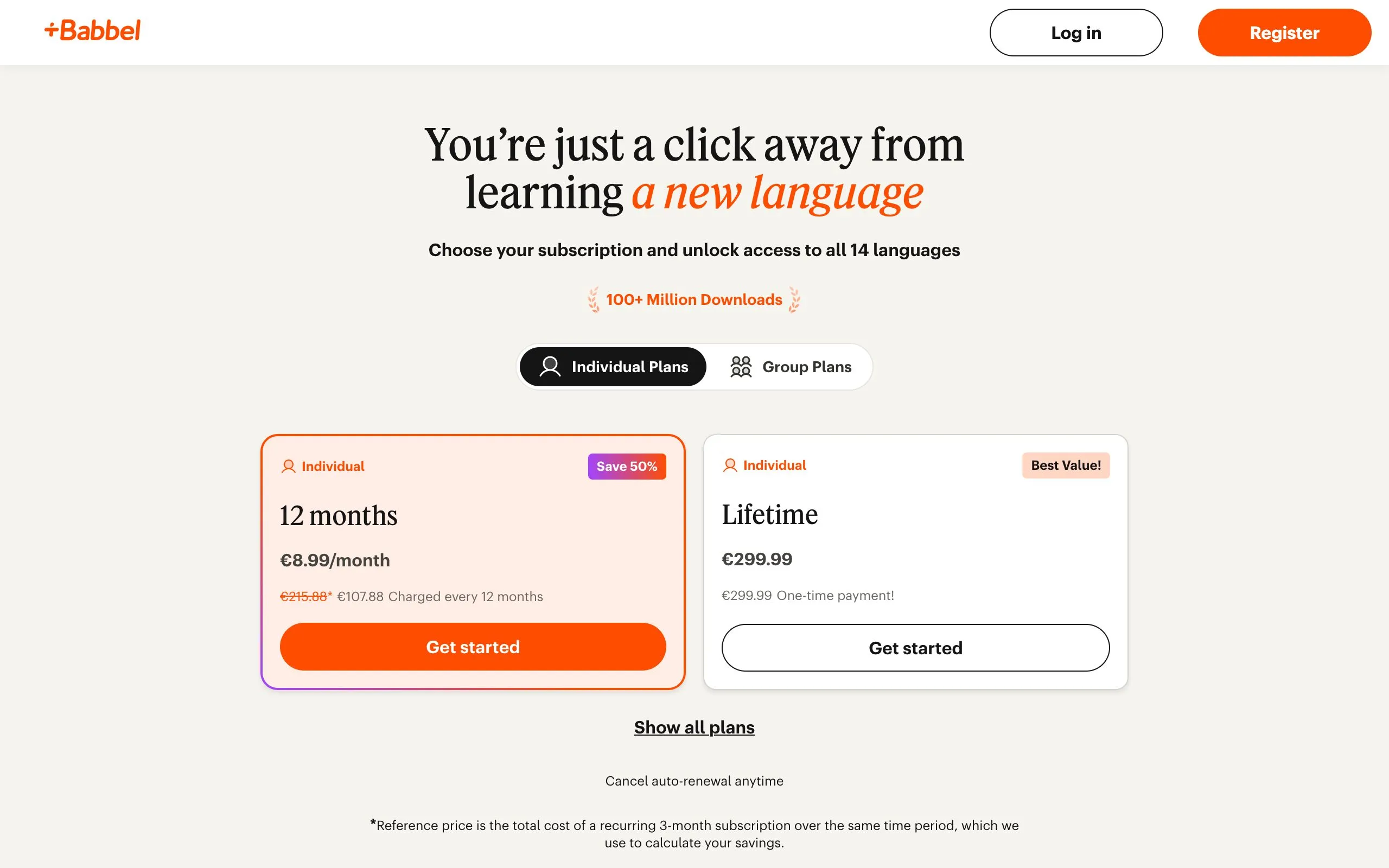
Which to buy: start with 3 months, because you’ll know by then whether you use it. If you do, the 12-month plan costs half as much a month. Lifetime costs as much as nearly three years on the 12-month plan, so it only pays off if you’ll use Babbel for years or for more than one language. A learner who studies several languages called it good value for that reason. One lifetime buyer is a warning: Babbel later removed features they had paid for, such as games and live classes.7
How far can Babbel take you in German?
To about A2. The course is generous at the start: one learner finished A1 in about two and a half months at a lesson a day. Then it shrinks. Learners who looked ahead in the app counted about 15 lessons at B1 against more than 90 at A1, and someone who had finished A2 found B1 much shorter and easier. B2 splits opinion: one learner found it much longer than B1, and another who finished it didn’t think their German was B2.8
Finishing a level in the app isn’t the same as being at that level. The people who report reaching B1 or B2, or passing an official exam, used Babbel for only part of the way. One went from zero to a B1 certificate in ten months: about four months on Babbel’s A1 to B1 levels for vocabulary and grammar, then the Michel Thomas audio course, German TV and six weeks of intensive classes. Their speaking confidence fell while they were mostly on the app, and the classes brought it back. Others did the same with classes, textbooks and exam preparation.9 For the route from A2 to B1, see our B1 guide.
Will Babbel actually get you speaking German?
Not on its own. The app has speech recognition and scripted dialogues where you say your part aloud, but you’re mostly speaking to your phone. People who learned mainly with the app say they wished they’d started real conversations sooner, or found it hard to get practice where they lived.
People who took Babbel’s old live classes reported clear speaking gains.10 For live classes now, see our Lingoda review. The free option is a tandem partner: a native German speaker who wants to learn your language, so you take turns. Apps such as Tandem and HelloTalk exist to find one. A tutor costs money but gives you feedback.
What does Babbel do well, and where does it fall short?
It does beginner grammar well: people who used Babbel and Duolingo mostly say Babbel explains German grammar better. Besides the thin B1 level and the lack of speaking, the main complaint is the review. Some say it repeats phrases they’ve just learned without making them stick, and that later lessons rarely reuse earlier grammar.11
Not everyone finds the grammar enough. A beginner a month in found the explanations helpful. Someone also taking a class at a Volkshochschule, an adult education centre, wanted more and found Babbel limited on grammar, cases (the endings that show a word’s role in a sentence) and vocabulary.12
What should you add to Babbel to pass an A1 or A2 exam?
Speaking and writing with real people. The A1 and A2 exams from the Goethe-Institut, Germany’s cultural institute, test all four skills. At A1 you fill in a form, write a short message and talk in a small group. At A2 you write about your life, and plan something together with a partner.13 Babbel’s exercises don’t put you in front of another person.
People who passed an A1 or A2 exam with Babbel added a course or classes, Nicos Weg, exam videos, and practice with friends or locals. The Goethe-Institut also has free practice materials.13 Speaking is the part to prepare for: one A2 candidate who had used Babbel, Nicos Weg and group lessons still found it very hard on the day. Our A1 guide and A2 guide cover what each level needs.
Babbel or Duolingo, Busuu or Nicos Weg?
- Duolingo is the one to pick if you want an app that’s fun to keep coming back to. Babbel is the one to pick for grammar: learners who used both mostly preferred it for that.14 See our Duolingo review.
- Nicos Weg is free, and several people who tried both preferred its story and videos.15 Moving the other way can show you what Babbel skipped: one learner found gaps in their grammar and listening when they started Nicos Weg. See our Nicos Weg review.
- Busuu also has a free course, and says it adds feedback from fluent speakers. One learner found it more enjoyable than Babbel, with useful vocabulary and cultural context, and found Babbel more intense, focused on grammar and vocabulary, with too little speaking.16
Sources
Footnotes
-
Babbel, German levels and imprint. The vendor’s claims. ↩
-
Nicos Weg or Babbel subscription? and Is babbel.com effective?, r/German. ↩
-
Babbel, Babbel review page. ↩
-
Babbel help centre, Babbel Speak. ↩
-
Which has more content, Duolingo or Babbel?, r/German; Babbel continues to remove features, r/babbel. ↩
-
Why is Babbel German B1 so short? and How realistic is Babbel’s level system?, r/German. ↩
-
Is Babbel Live good for B1?, r/German; My path to B1, The Awesome German Language. ↩
-
Three-month recap of Babbel Live, r/languagelearning; App or website to help me become an A2, r/German. ↩
-
Anyone else find Babbel kind of lacking? and a reply, r/babbel. ↩
-
How good is babbel.com? and a later reply, r/German. ↩
-
Goethe-Institut, Goethe-Zertifikat A1 and Goethe-Zertifikat A2. ↩ ↩2
-
Learning app opinions and Babbel vs Memrise vs Duolingo, r/German. ↩
-
Nicos Weg or Babbel subscription? and Nicos Weg, r/German. ↩
-
Busuu, German course, the vendor’s claims; Deutsch lernen, r/SaudiLanguageLearners. ↩